
How Do Porta Potties Work?
No pipes, no water line, no drain. That's the whole point. A standard porta potty rental is a sealed unit sitting on its own footprint, about 44 by 48 inches on the ground and 92 inches tall. Underneath the seat is a holding tank, 60 to 70 gallons, filled partway with a blue deodorizing liquid before it ever reaches your site. That liquid is the "portable toilet chemicals" people search for. It breaks down solids, knocks back odor, and keeps the tank from turning into a problem before the next pump-out. There's no flush handle on the basic unit. Waste drops straight into the tank. A vent stack pulls odor up and out rather than back into the stall. When the service truck comes, a tech vacuums the tank, refills the chemical charge, and restocks paper. For jobs that need something closer to a bathroom at home, the deluxe flushable porta potty adds a foot pump or hand pump that pulls fresh water to rinse the bowl after each use, which is the "how do flushable porta potties work" answer in one sentence: same sealed tank below, just a rinse cycle on top.
How Does a Portable Sink Work?
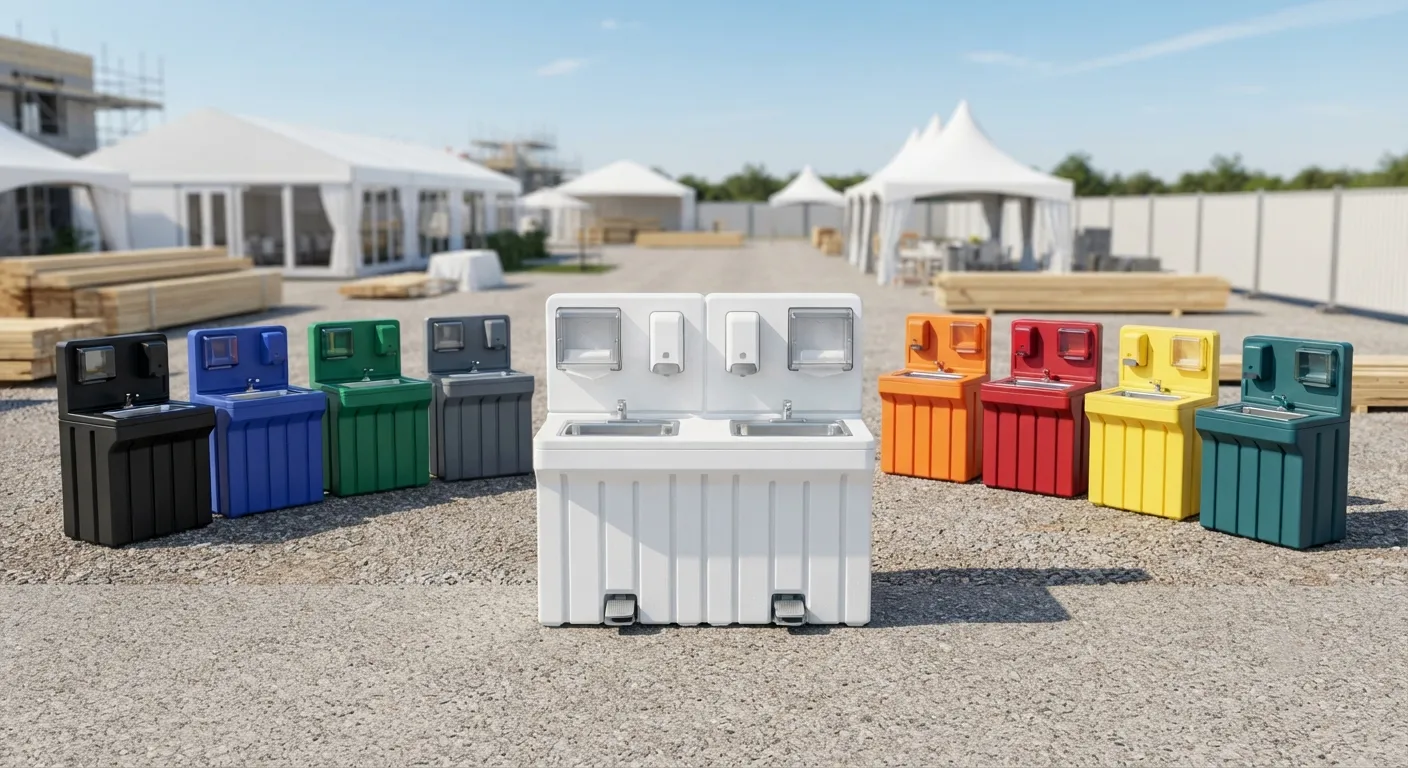
A portable sink runs on its own fresh water tank and a foot pump, no faucet line required. Fresh water sits in a top reservoir, a foot pedal pushes it through the tap, and gray water drains into a separate holding tank underneath. Soap dispensers mount on the unit itself. This matters because 29 CFR 1910.141(d)(2) requires soap and towels or a hand-drying device at washing stations, and hand sanitizer alone does not satisfy it. A handwashing station rental or portable sink rental gets paired with toilets on most South Gate job sites for exactly that reason. Crews using paint, coatings, herbicides or insecticides fall under a stricter rule, OSHA 1926.51(f)(1), which specifically requires washing facilities for those contaminant exposures. If your South Gate crew is spraying or coating anything, that's the standard to check against, not the general sanitation rule. See handwashing requirements for how the two rules split.

Why Does a Construction Worker Need to Walk to a Porta Potty on Site?
Because OSHA sets a ratio, not a guess. Under OSHA 1926.51(c), a construction site needs one toilet for every 20 workers on crews of 20 or fewer, climbing to one toilet seat and one urinal per 40 workers as headcount grows past that, and one per 50 once you're at 200 or more. A construction worker running to a porta-potty across a long site isn't a planning failure, it's usually a placement problem. Our porta potty placement guide and how many porta potties do I need tool both walk through spacing so nobody's making a 5 minute walk mid-shift. Farms and ag operations answer to a different rule, OSHA 1928.110, which calls for a facility within a quarter mile walk of hand-labor crews. Check farm and agricultural restrooms and construction site services for South Gate-specific setups, and OSHA portable toilet requirements for the full ratio table.
How Do Camping Porta Potties Work Compared to Job Site Units?
Camping units are smaller and self-contained, built for one or two people over a weekend rather than a rotating crew over months. They still use the same core idea: a sealed tank, a chemical charge, no plumbing. The difference is scale and service interval. A job site unit under portable toilet rental gets serviced on a set cadence tied to crew size, while a camping porta potty is often a one-time drop and pickup. ANSI/PSAI Z4.3 sets the baseline service interval at once a week for up to 10 users across a 40 hour week, which is the standard most South Gate rental schedules are built around before adjusting for higher traffic. For anyone weighing ADA needs on a job site or at an event, ADA accessible porta potty units meet ADA Standards 213.2, which requires at least 5 percent of a cluster of units be accessible, with a minimum of one no matter how small the cluster.
| unit | day | week | month |
|---|---|---|---|
| standard | 100-350 | 130-500 | 125-325 |
| ada | 200-400 | 120-240 | n/a |
| deluxe | 85-1200 | 150-290 | n/a |
South Gate sites near Cudahy, 2.4 miles northeast, and Bell, 3.5 miles north, run the same rental math. Delivery fees run separately; see porta potty rental cost and porta potty rental per day for the full breakdown, or request a quote direct from South Gate Porta Pros.
Do porta potties smell bad if they're serviced on schedule?
Not if the chemical charge and pump-out schedule are holding. Odor control depends on the deodorizing liquid staying active and the tank not overfilling between visits. See do porta potties smell for what drives odor and how South Gate Porta Pros schedules around heat and heavy use.
What septic tank cleaning chemicals get used, and are they the same as porta potty chemicals?
Different job, different chemistry. Septic tanks rely on bacterial breakdown and get pumped every 3 to 5 years depending on tank size and household size. Porta potty tanks use a deodorizing chemical, not a bacterial treatment. Check septic pumping service and how often to pump a septic tank for details.
Can a portable sink freeze in winter in South Gate?
South Gate rarely sees hard freezes, so this is a minor concern here compared to colder climates. Fresh water tanks can still slow down in cold snaps. See porta potty in winter for cold-weather service notes that also apply to sinks.
Is a permit needed to place a porta potty on a South Gate street?
Placement in the public right of way needs confirming with the city before delivery. See porta potty permit requirements and dumpster permit requirements for what to check before your unit lands.
How often does a porta potty get cleaned on an active job site?
Weekly service is the common baseline for moderate crews, per ANSI/PSAI Z4.3, but high-traffic South Gate sites often move to twice weekly. See how often are porta potties cleaned for how crew size changes that schedule.
Next step
Get a delivery date
Tell us the address, the dates and the headcount. We size the order and confirm the route.